Silicon-to-System Engineering Execution & Technical Advisory
ORTENGA operates as a silicon-to-system engineering leadership model that helps organizations execute complex technology programs through disciplined engineering methodology, structured Statements of Work, and coordinated technical leadership across hardware, silicon, firmware, software, and system-level architectures.
Why ORTENGA Exists
ORTENGA was established in 2016 from repeated observations across high-technology programs where organizations began spending capital, building teams, or initiating development before establishing sufficient system-level clarity.
In many cases, the assumption is that starting earlier accelerates time-to-market. However, engineering execution without audited direction can introduce unintended technical risk, fragmented decision-making, and costly downstream correction cycles.
The challenge is often not engineering effort alone, but ensuring that product direction, system assumptions, constraints, interfaces, and success criteria are properly established before implementation begins.
Many engineering risks emerge long before implementation problems become visible.
ORTENGA was established around that principle.
ORTENGA Engineering Risk & RoI Blueprint™
Successful products depend on three distinct, sequential engineering phases:
→
Design
→
Validate
The sequence is not interchangeable.
Each phase establishes the foundation for the next.
Audit — Product Definition and Risk Alignment
Establish the true product intent, operational objectives, constraints, assumptions, use cases, and success criteria before major engineering execution begins. The audit phase evaluates whether the technical direction, market assumptions, and system-level architecture are properly aligned before development complexity and investment commitments compound over time.
Design — System Architecture and Technical Decomposition
Convert audited intent into executable engineering architecture, technical decomposition, interfaces, implementation strategy, and traceable system requirements across hardware, silicon, firmware, software, and integrated system behavior. The design phase establishes the engineering structure required for disciplined execution.
Validate — Engineering Development and Execution
Implement, integrate, and validate the product against the original audited intent. Validation ensures that what is built aligns with the technical objectives, market needs, and investment assumptions before scale, tapeout, or deployment lock in cost and timeline.
The ORTENGA Engineering Risk & RoI Blueprint™ was developed to reduce unintended execution risk before development complexity, organizational momentum, or downstream correction costs compound over time.
About ORTENGA
From Silicon to System — Engineering Excellence Delivered
ORTENGA is an engineering leadership organization specializing in antenna, ASIC, algorithm, AI, and wireless communication systems. The organization helps companies execute complex technology programs through disciplined engineering methodology, structured Statements of Work, and coordinated technical leadership across hardware, silicon, firmware, software, and integrated system architectures.
The focus is not simply engineering participation — it is engineering execution with clarity, traceability, and measurable delivery outcomes.
ORTENGA supports high-technology startups, established technology companies, investors, and IP law firms where system-level engineering clarity, execution discipline, and technical defensibility materially impact outcomes.
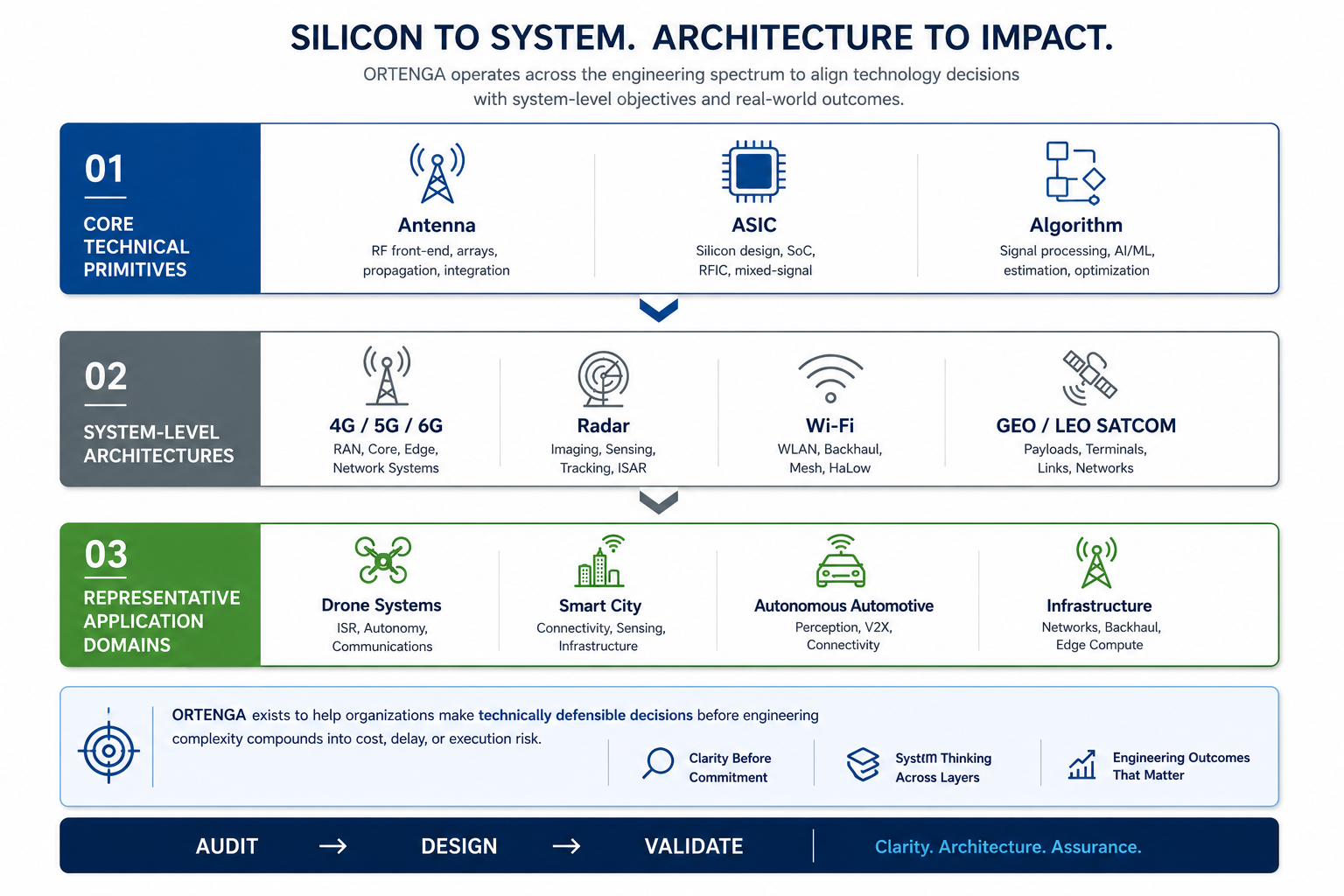
Silicon-to-System Technical Execution Framework
ORTENGA operates across multiple layers of technical execution, connecting core engineering primitives to system architectures, integrated product behavior, and application-level outcomes.
The framework below reflects how ORTENGA evaluates engineering direction, architectural dependencies, implementation alignment, and technical defensibility across complex technology programs.
Leadership
Shahram Shafie
— Founder & Principal Engineer
Shahram Shafie is the founder of ORTENGA and leads system-level technical engagements spanning antenna, ASIC, algorithm, AI, and wireless communication systems.
His background includes 18 years in semiconductor and wireless system development across organizations including Conexant Systems and Qualcomm, with work spanning RFIC architectures, baseband SoC platforms, Wi-Fi, Bluetooth, radar systems, SATCOM, and wireless communication architectures.
He holds an M.S. in Electrical & Computer Engineering from the University of Massachusetts Amherst with specialization in Microwave Engineering and Radio Communication Systems, and has taught Antenna Theory & Design and Principles of Wireless Electronic Systems at the University of California San Diego and the University of California Irvine.
His work includes system architecture, technical due diligence, engineering execution leadership, and engineering interpretation in high-stakes technical and IP environments.
Learn More
ORTENGA engages selectively with organizations where system-level engineering clarity, execution discipline, and technical direction materially impact outcomes.