Engineering Clarity Before Commitment
ORTENGA exists to help organizations reduce engineering uncertainty before critical investments in product development, scaling, system deployment, and IP strategy.
Successful products are rarely determined by technology alone. They are determined by how clearly system objectives, constraints, architectures, and execution paths are defined before implementation begins.
Our Mission
At ORTENGA, our mission is to bring system-level engineering clarity to complex technology decisions.
We help organizations translate product vision into executable engineering direction through structured technical assessment, architecture definition, and validation planning.
This is why ORTENGA operates through the sequential framework of Audit → Design → Validate.
The sequence is not interchangeable. Each phase establishes the foundation for the next.
Why ORTENGA Exists
Modern engineering organizations face increasing pressure to accelerate development while managing growing technical complexity across silicon, RF, software, AI, communications, and system integration.
In many cases, engineering risk is introduced long before implementation begins.
Undefined product assumptions, misaligned system requirements, architecture decisions made without system-level validation, and market constraints discovered too late often compound into redesign cycles, schedule delays, and increased investment risk.
ORTENGA was created to address the gap between technical capability and system-level execution clarity.
System Before Silicon
At ORTENGA, we believe engineering decisions should be driven by system objectives first — not isolated component optimization.
Successful systems emerge from the interaction between core technical primitives, system-level architectures, and application-domain requirements.
ORTENGA operates across these layers to help organizations align engineering execution with system-level outcomes.
Core Principles
- Architecture Before Optimization
- System Objectives Before Components
- Execution Clarity Before Scale
Silicon to System. Architecture to Impact.
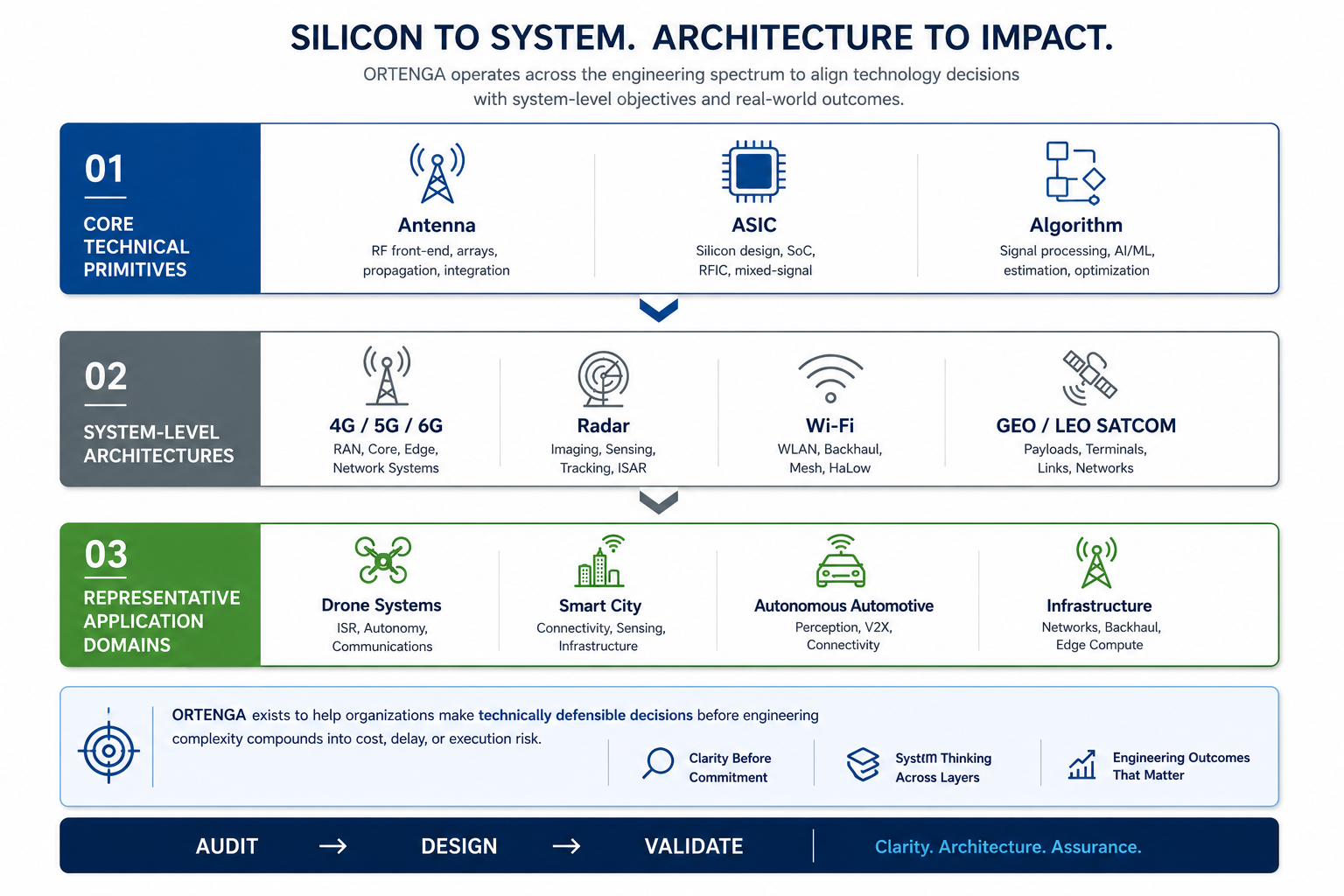
Audit → Design → Validate
Audit
Establish the true product intent, operating constraints, technical assumptions, and system-level objectives before architecture decisions are finalized.
Design
Translate validated objectives into executable system architectures, engineering requirements, trade studies, and implementation pathways.
Validate
Verify that the implemented system aligns with the original technical intent, operational objectives, and market assumptions before scale or deployment.
Engineering Clarity Before Complexity Compounds
ORTENGA works with organizations seeking structured engineering direction before technical complexity compounds into execution risk, redesign cycles, or delayed market outcomes.