- Engineering Insight for High-Stakes IP and Technology Decisions
- Intellectual Property and Patent Services
- Apple C1 MODEM
- Patent Infringement
- Antenna Patent Investigations
- Patent Portfolio Assessments
- Code Review
- Validating Patent Infringement by Test
- Envelope Tracking Patent Investigations
- Patent Draft Challenges
- Artificial Intelligence Reviewing Intellectual Properties
- Why Patent Infringement Happens?
- What invention worth to be patented?
- Designing Patents for Licensing, Damages, and Enforcement
Engineering Insight for High-Stakes IP and Technology Decisions
ORTENGA provides independent, system-level technical assessment and execution support for high-tech programs where risk, capital, and credibility are on the line.
We operate from silicon to system, applying deep engineering judgment to help clients make informed decisions—early, clearly, and defensibly.
IP Portfolio Assessment & Value Recovery
When a high-tech startup underperforms or fails to return expected investment, its product may fail—but its IP often does not.
ORTENGA helps VCs and IP law firms determine whether a portfolio should be salvaged, repositioned, or abandoned, before additional capital is committed or written off.
What We Do
We conduct an independent, cross-domain IP portfolio assessment, evaluating technical substance and reuse potential beyond the original product or market.
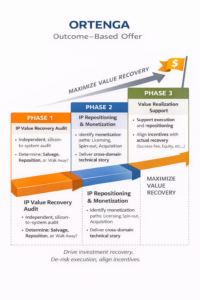
Our analysis spans:
- Core technical primitives: Antenna, ASIC, Algorithms (including AI-enabled signal processing)
- System architectures: 4G/5G/6G, Radar, Wi-Fi, GEO/LEO SATCOM
- Representative application domains: Drone systems, Smart City infrastructure, Autonomous Automotive platforms
What Clients Receive
- A clear salvage vs. reposition vs. walk-away recommendation
- Mapping of IP applicability across multiple industries and systems
- Identification of realistic monetization paths (licensing, spin-out, acquisition)
- A coherent technical narrative investors and counsel can stand behind
This offering is designed to replace fragmented SME opinions and product-level thinking with holistic, defensible engineering judgment.
System-Level Engineering Execution (SoW Delivery)
For active high-tech programs, ORTENGA delivers complex Statements of Work predictably through a proven network of Antenna, ASIC, and Algorithm engineers.
Engagements are structured around system-level execution, aligning business objectives with technical delivery across:
- 4G/5G/6G wireless
- Radar and sensing systems
- Wi-Fi and SATCOM architectures
Supporting applications include Drone, Smart City, and Autonomous Automotive programs where cost, schedule, and technical risk must be tightly controlled.
What This Enables
- Faster execution without technical blind spots
- Reduced integration and rework risk
- Clear ownership across hardware, firmware, and algorithms
- Engineering decisions that remain valid as systems scale
How ORTENGA Is Different
- Silicon-to-System Perspective
We evaluate technology at the level where IP and execution risk actually live—not in isolation. - Unified Technical Judgment
One cohesive technical team replaces fragmented SMEs and conflicting opinions. - Independent and Outcome-Driven
Our role is clarity, not volume of work. We optimize for decisions, not hours.
When to Engage ORTENGA
- A startup has failed or underperformed and IP value is uncertain
- Investors need an independent technical view before salvaging or exiting
- An IP portfolio spans multiple technologies or verticals
- A complex SoW must be executed without schedule or budget surprises
Start with a Technical Assessment
If the stakes are high, clarity should come first.
[Explore IP Portfolio Assessment]
[Start with a Technical Assessment]
Intellectual Property and Patent Services
Innovation is the engine of success in the high-tech industry — and intellectual property (IP) sits at the core of that innovation. Strong IP protection enables companies to monetize their ideas, safeguard their competitive advantage, and ensure returns for all stakeholders.
Patent applications are the key artifacts that establish ownership of IP.
Partner with ORTENGA to protect your patent portfolio or defend against false infringement claims.
ORTENGA has a team of seasoned engineers who thrive in an entrepreneurial, collaborative environment. We design and develop innovative solutions across Antenna, ASIC, and Algorithms projects, bringing deep technical rigor to every engagement.
In addition to our engineering services, ORTENGA provides specialized intellectual property support tailored for deep-tech companies — including patent drafting, claim-chart analysis for litigation and licensing, prior-art research, and expert-witness services.
Our subject-matter expertise spans 3GPP (4G, G, 6G), 802.11/WiFi, Radar, and SATCOM industries.
Apple C1 MODEM
Apple 5G MODEM SoC is named C1.
C1 is engineering work of at least a decade and has been anticipated almost in the same number of years.
C1 is expected to be backward compatible with 4G and 3G and is advertised as the most efficient power consumption MODEM in the market.
Apple and Qualcomm have been in ASIC and mobile phone business relationships for a long time.
Their relationship has gone through many ups and downs.
In the past Apple sued Qualcomm regarding royalties, yet they were finally settled outside of the court.
On the other hand, Qualcomm has significant mobile handset critical IPs. Some of which are expected to impact many devices.
As Apple introduces iPhone16E with C1, it would be impacting Qualcomm bottom lines. How would Qualcomm return the over a decade favor?
ORTENGA has seasoned engineering from Autonomous Automotive, eHealth, SATCOM, radar, Smart City, WiFi, Mobile Terrestrial Radio Communications, and 6G industries in Antenna, ASIC, HW, FW, and SW engineering disciplines.
Patent Infringement
Many high-tech corporations have legal departments which handle filling, monitoring, and litigating patents infringement.
Their job is to assess and protect intellectual property, IP of that organization and sometime even buying key IPs so that they could stay in business.
This is where highly meticulous engineering who are tech-savvy as well as understand the legal terminology have a place at the table.
ORTENGA has been at that table and pursued patent infringement by helping our client to recover large sum.
This involved review and analyzing related patent and meticulously decomposing and parsing claims and preparing technical validation for every single claim and statement in the patent.
The patent could have ASIC, HW, FW, and/or SW implications which needs to be litigated.
ORTENGA helps businesses to identify required technical features to realize their business goals and realize the return of investment.
Antenna Patent Investigations
5G, 6G, WiFi7, and Autonomous Automotive rely on multi-antenna technology.
Every product that supports 5G, 6G, WiFi7, and Autonomous Automotive would require to have a unique multi-antenna technology to avoid infringing on related antenna patents.
ORTENGA provides patent review, analysis, and antenna design implementations to identify and file claim charts for any patent infringement in Radio Communications or Radar systems.
Patent Portfolio Assessments
ORTENGA evaluates patent and IP for clients.
Design and development of new technology requires multiple engineering skills and disciplines, consequently costly.
In addition, implementing out of box ideas can take anywhere between few to several years before become a prototype.
Then, the prototype needs to go through another layer of development before it becomes a commercial product.
At the end, that product would be evaluated by the market and may not return the investment.
In light of that, many corporations reduce the risk of new technology development by investing on appropriate startups that are promising.
The corporations’ investments in these startups guarantee them an opportunity for visibility into the startups progress. Consequently, if the startups are successful in delivery of their prototype or product, they would be merged to the investing corporation.
Having technical know-how to review patents and identify the patent applicability to various applications allows corporations to make appropriate investment for 5G, 6G, WiFi, Autonomous Automotive, and Radar market.
Partner with ORTENGA for Architecture, Antenna /ASIC /Algorithm design patents’ assessments and their applicability for future related markets.
Code Review
Typically, algorithms are implemented either in FW or SW.
ORTENGA offers code reviews and reverse engineering.
Analyzing codes can lead to identifying the algorithm being implemented.
If your patent is infringed upon, then analyzing codes would validate and provide artifact for claim charts and export reports.
Augment ORTENGA for IP assessments and investigations.
ORTENGA offers 3GPP (4G, 5G, 6G), 802.11 (WiFi), and SATCOM patent portfolio assessment, claim chart, expert report and testimony services.
ORTENGA is composed of seasoned engineers who collaborate on innovative design in an entrepreneurial environment to accomplish clients’ projects.
Validating Patent Infringement by Test
Patent claims could be composed of HW, FW, and/or SW implementations.
Therefore, any traceability for patent infringement not only has HW artifacts but also has FW and/or SW signature which are not obvious unless can be validated by additional tests.
These tests have to be meticulously designed to unequivocally show the patent under investigation is infringed.
To validate FW and/or SW, Design of an Experiments, DOE have to be articulated to show unequivocally the patent is infringed.
Partner ORTENGA for design and development a patent infringement DOE.
Envelope Tracking Patent Investigations
5G, gNB, and 6G Mobile Handsets rely on Envelope Tracking, ET technology.
Every Mobile Handsets product which requires power saving mechanism to extend battery life cycle utilizes ET HW and Algorithms.
ORTENGA provides patent review, analysis, and ET design implementations to identify and file claim charts for any patent infringement in Mobile Communications systems.
Patent Draft Challenges
Patent is an artifact which is supposed an invention from being used by unauthorized users.
If someone wants to use that invention, then needs to get authorization form the owner of the patent. Consequently, a patent can be used for monetization of an invention.
In order to have effective monetization, the patent has to be drafted in a such a way that its claims cover all potential use cases that may not be apparent to the inventor(s) at the time of invention.
The inventors know about the specific technical problem that they face and come up with a smart way of addressing that problem which did not exist before, hence invention.
That invention however could have applications in other areas, for example Hedy Lamaar and George Antheil invention of CDMA.
The patent agent should draft all use cases, not just the one was in the mind of inventors.
Another challenge in drafting a patent arises when there are ambiguous words that have multiple interpretations and may not be known to the inventor.
For instance, the word “gain” has multiple meanings depending where it is used, in ASIC or Antenna content. There are multiple gains, amplifier gain is different than mixer gain or antenna gain. Therefore, the patent agent has to be knowledgeable to know the differences and articulate enough to draft the claim appropriately.
Another example could be the different between “after” and “follows”, do they mean the same thing? Or what each word mean in daily life? And how should be interpreted in the context of technical patent?
Understanding the implications of language in various context and technical fields require broad knowledge and mindfulness in drafting any patent to withstand future challenges.
Partner with ORTENGA to draft your technical invention into a patent.
Artificial Intelligence Reviewing Intellectual Properties
Artificial Intelligence, AI would be utilized to review Intellectual Properties, IP or patents.
This would be new feature or service of AI with paid subscription options for the end technical or business users.
AI would require to be trained by subject matter exports in various technical fields.
Every patent follows certain format, therefore there are patterns to all patents.
In addition, there is a application specific terminology that apply to Antenna and ASIC technologies or industry which can be integrated into AI.
The application specific terminology is utilized in every patent.
Partner with ORTENGA for your Antenna, ASIC, or Algorithm patent prosecution, litigation, or AI training.
Why Patent Infringement Happens?
Patent infringement hardly occurs maliciously or knowingly.
There are two main reasons that patent infringement occurs:
- The patent of interest was not known to the party which is utilizing it for its design or product.
- The patent of interest was not clear or did not foresight of other applications.
Corporations typically do not fall in first reason above, as they have adequate engineering and skillful resources who search for prior art and ensure patent infringement does not occur.
Startups may not have adequate resources beside the designer to thoroughly evaluate prior arts, unless the designer is work on a project with the same application as the patent of interest.
Both corporations and startups can fall under the second category above.
When a patent is drafted and does not necessarily mention all its applicable utilization, then it can be overlooked during the patent prior art search. Also, because of that the patent’s claims language maybe vague. The patent vague language could be exploited or interpreted as irrelevant, therefore the patent is ignored.
The second above reason can be avoided if the patent and its claims are drafted from various applications perspective.
Partner with ORTENGA for design audit, validation, patent services, design and development of antenna.
Designing Patents for Licensing, Damages, and Enforcement

Patent execution is costly and often takes several years. The fundamental purpose of a patent is to prevent others from using your invention in product design and development unless they are prepared to compensate you.
That compensation may take different forms—licensing royalties, a one-time fee, or outright acquisition of the patent. In all cases, the return on investment (ROI) of a patent depends on one critical factor: practical applicability.
If an invention solves a real problem and enables a commercially viable product, anyone adopting it will expect to generate meaningful value from their investment. That is what ultimately justifies patent protection.
However, if an invention is not practical—or not aligned with market needs—at the time of filing, there is a real risk it may never be adopted. In such cases, the patent may never deliver a return, regardless of its technical novelty. Inventors must therefore make a careful decision: is the invention worth the financial investment and the time required to secure patent protection?
The Right Question Is Not “Can It Be Patented?”
But “Will It Be Used?”
This is where technical depth and market insight must come together.
Partner with ORTENGA to objectively review your invention, assess its technical merit, and evaluate its applicability across existing and future markets.
ORTENGA brings seasoned engineering and system-level expertise across:
- Autonomous Automotive
- SATCOM
- Radar Systems
- Smart City Infrastructure
- Wi-Fi and Mobile Terrestrial Radio Communications
- Emerging 6G Technologies
Our approach helps inventors, startups, and technology leaders make informed patent decisions—focusing on inventions that can translate into real products, real adoption, and real returns.