- Delta Sigma Modulator, DSM
- What is Dithering and why it is used?
- What is Interleaving and Why it is used?
- SERDES
Delta Sigma Modulator, DSM
Ultra wide bandwidth data converters, ADC and DAC are becoming required for many applications, such as; advanced radio communications and radar systems.
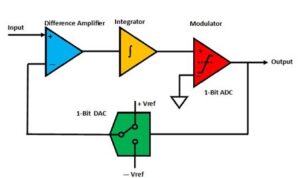
UWB data converters enable monitoring/generating multiple signals within the overall system whether that is radio communications or radar applications.
In radio communications, the faster response time translate to shorter processing time for multiple signals.
In radar, the faster response time translate to shorter time to be aware of multiple targets.
DSM architecture can be configured for high resolution and low noise for UWB applications.
ORTENGA helps businesses to identify required technical features to realize their business goals.
ORTENGA provides structured engineering leadership across antenna architecture, realization planning, integration, and deployment validation to reduce downstream realization risk and improve alignment between engineering execution and business objectives.
→ Explore ORTENGA Structured Execution Model
→ Assess Your Project Risk Profile
What is Dithering and why it is used?
Dithering is a technique of reducing spurious unwanted signal which are unavoidable due to design architecture.
By modulating the unwanted spurious signal with wide band noise, the spurious signal can be reduced by several dB and in some cases suppressed below noise floor.
It is analogous to putting out fire by fire.
Dithering has applications in PLL, DSM, ADC, and DAC where spurious signals are number of one challenge for operational success.
ORTENGA provides structured engineering leadership across antenna architecture, realization planning, integration, and deployment validation to reduce downstream realization risk and improve alignment between engineering execution and business objectives.
→ Explore ORTENGA Structured Execution Model
→ Assess Your Project Risk Profile
What is Interleaving and Why it is used?
Interleaving is the process of placing/shuffling bits within a symbol in such a way that decrease the chance of “Burst Errors” due to fading.
There are two class of interleaving, Block and Convolutional.
Block interleaving is when the symbol is written into row of a matrix and transmitted along the column of that matrix.
Pseudorandom Block interleaving is subclass and when the symbol is written into row of a matrix and transmitted in the pseudorandom mechanism.
Convolutional interleaving is when the symbol is multiplexed in and out of fixed number of shift registers.
ORTENGA provides structured engineering leadership across antenna architecture, realization planning, integration, and deployment validation to reduce downstream realization risk and improve alignment between engineering execution and business objectives.
→ Explore ORTENGA Structured Execution Model
→ Assess Your Project Risk Profile
SERDES
Serial to De-serializer, SERDES plays a key role in AI data processing.

AI processor has to crunch massive amount of data.
The data goes between multiple chips or IP blocks within the ASIC.
ORTENGA provides structured engineering leadership across antenna architecture, realization planning, integration, and deployment validation to reduce downstream realization risk and improve alignment between engineering execution and business objectives.
→ Explore ORTENGA Structured Execution Model
→ Assess Your Project Risk Profile